
What EvalTrack is
EvalTrack is an institutional examination management product. It connects examination configuration, anonymous faculty assessment, institutional result publication, independent review, and institutional decisions through a connected examination record.
The homepage lifecycle introduces this relationship visually. This guide explains the operations, responsibilities, and publication states in reading order.
Who it serves
- Institutional administrators
- Configure academic scope and question groups, manage eligible participation and assignments, review evidence readiness, publish outcomes, and record institutional review decisions.
- Assigned faculty
- Assess institution-reviewed anonymous work and submit question-level marks against the configured scoring requirements.
- Eligible independent reviewers
- Assess certified anonymous evidence for an assigned review case, without baseline marks in the reviewer’s assessment view.
- Students
- View their currently issued examination outcomes. An adopted revision awaiting publication does not replace the result they currently see.
The examination lifecycle
Examination configuration and question groups
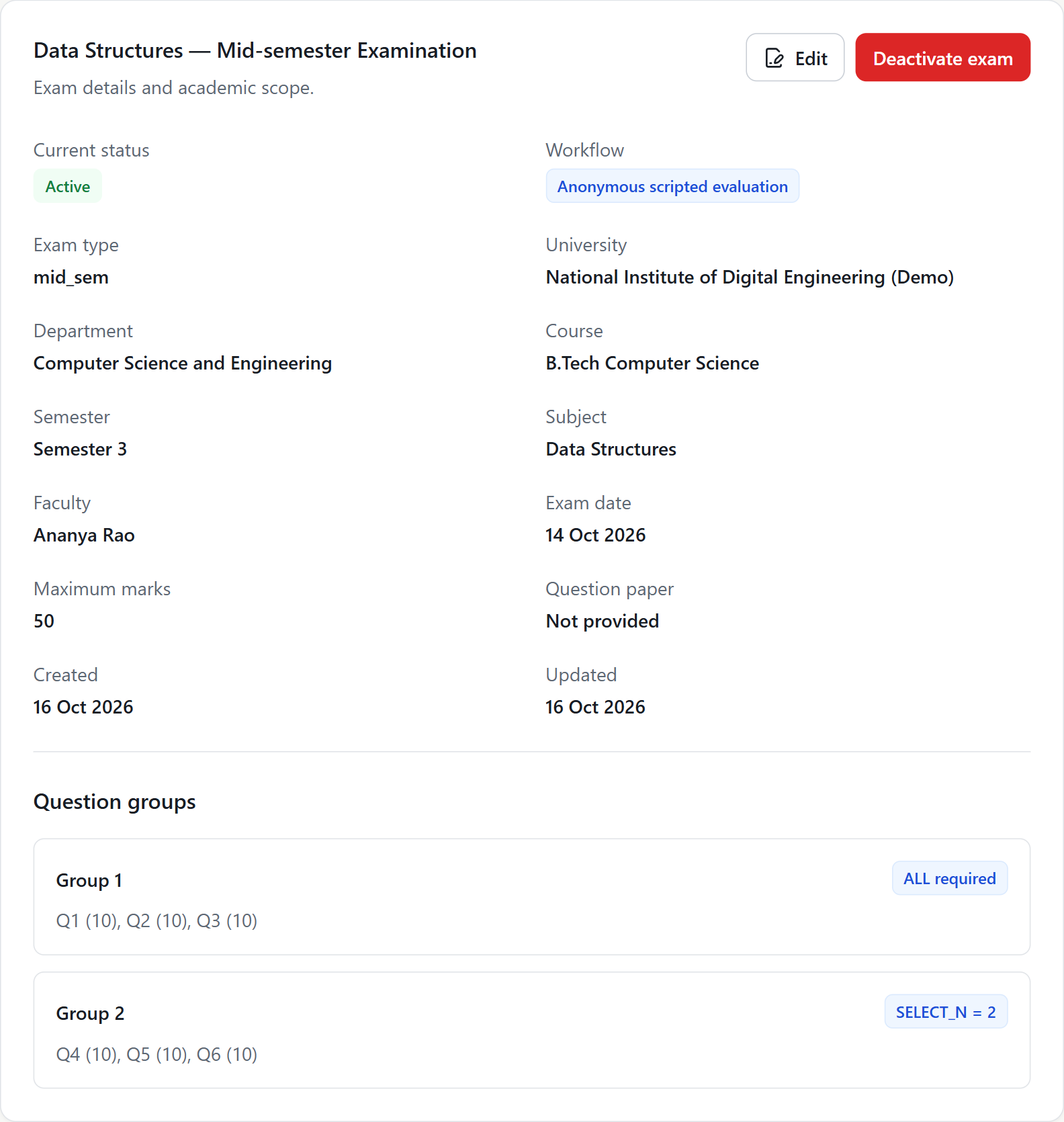
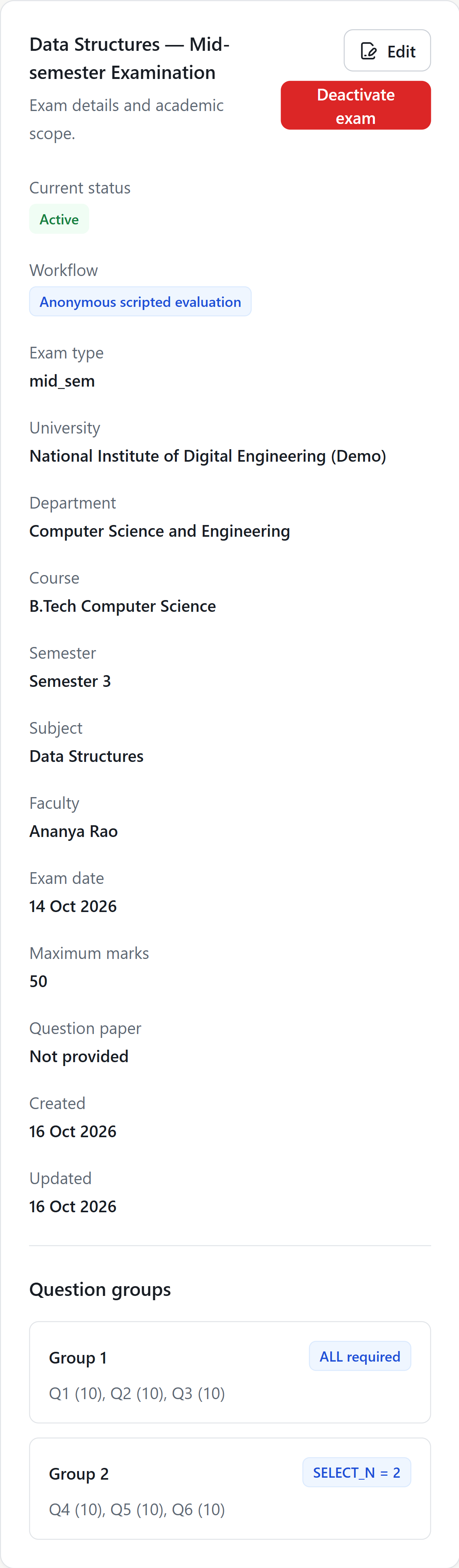
The institution defines the academic context, maximum marks, assigned faculty, and eligible participation. Question groups distinguish compulsory questions (ALL) from a required selection (SELECT_N). The demonstration uses Q1–Q3 as compulsory and two selected questions from Q4–Q6.
Anonymous faculty assessment
Assigned faculty assess an anonymous copy that the institution has reviewed and made ready. They record question-level marks and submit the assessment. Drafting and submission are separate from official result publication.
Participation accounting and initial publication
The institution reconciles attendance, accounts for the cohort, seals it, and publishes the initial issue. This establishes the official result students see and the issued baseline used by a subsequent review.
Independent review against the issued baseline
An institutional case connects the issued result to certified anonymous evidence and an eligible independent reviewer. The reviewer assesses the anonymous evidence without baseline marks. The submitted scoring membership stays fixed during review.
Institutional decision
The institution records a decision to keep the issued result or adopt the reviewed assessment. Keeping the issue preserves the official result. Adoption selects a revised candidate awaiting publication.
Separate publication of an adopted revision
The institution publishes the adopted candidate through a separate operation. Until that publication, the previously issued result remains official and remains visible to the student.
Following the record
Question-level assessment, the issued outcome, independent review, and institutional decision stay connected to their examination context. The institutional case retains its issued baseline and review state; the decision distinguishes keeping that issue from adopting a candidate for later publication.
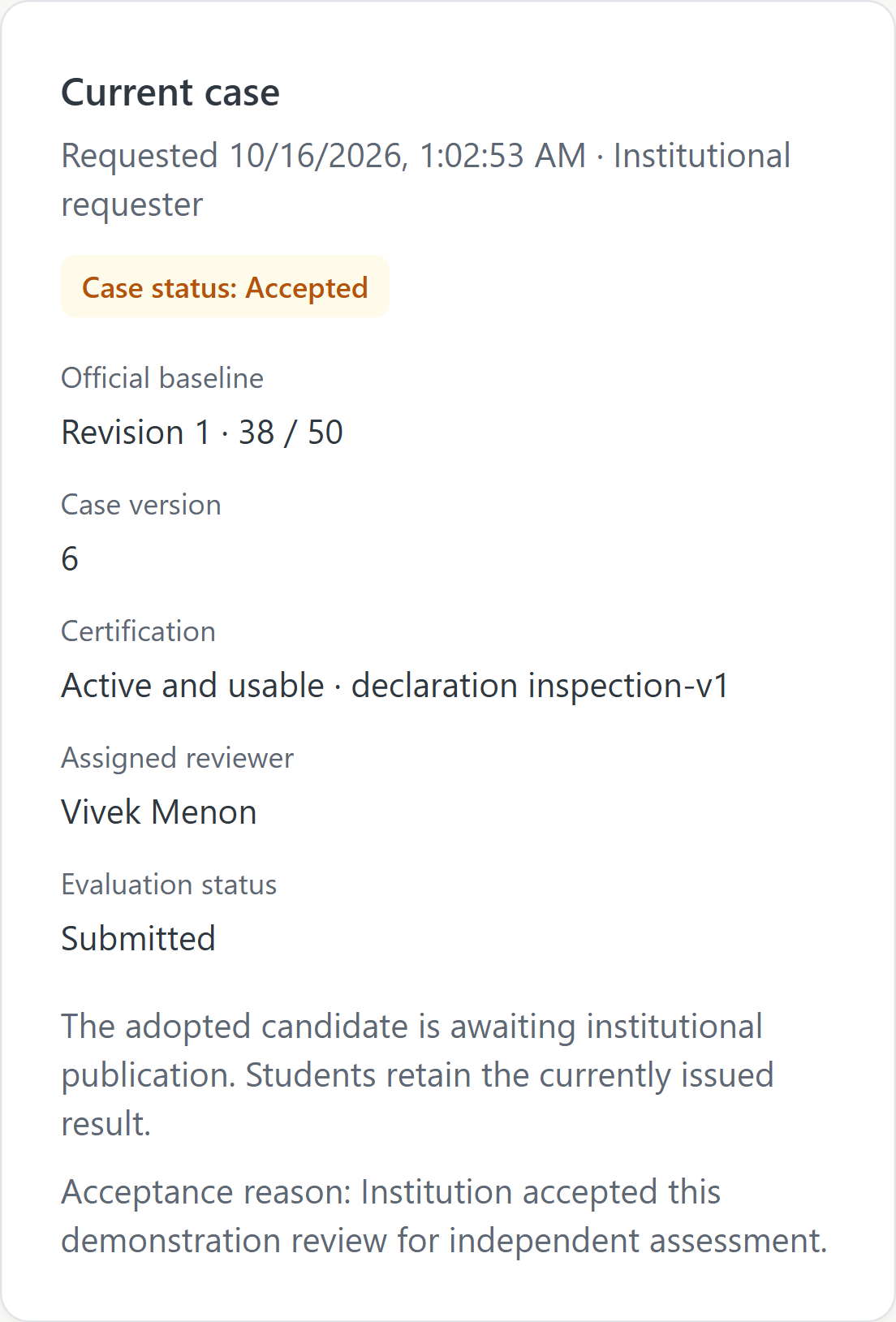
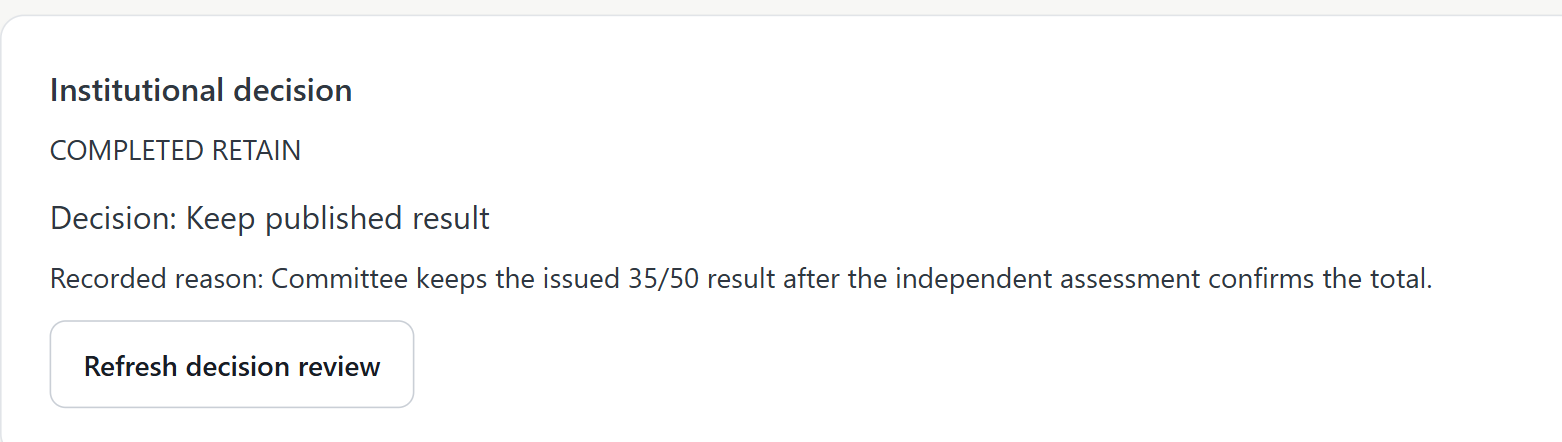
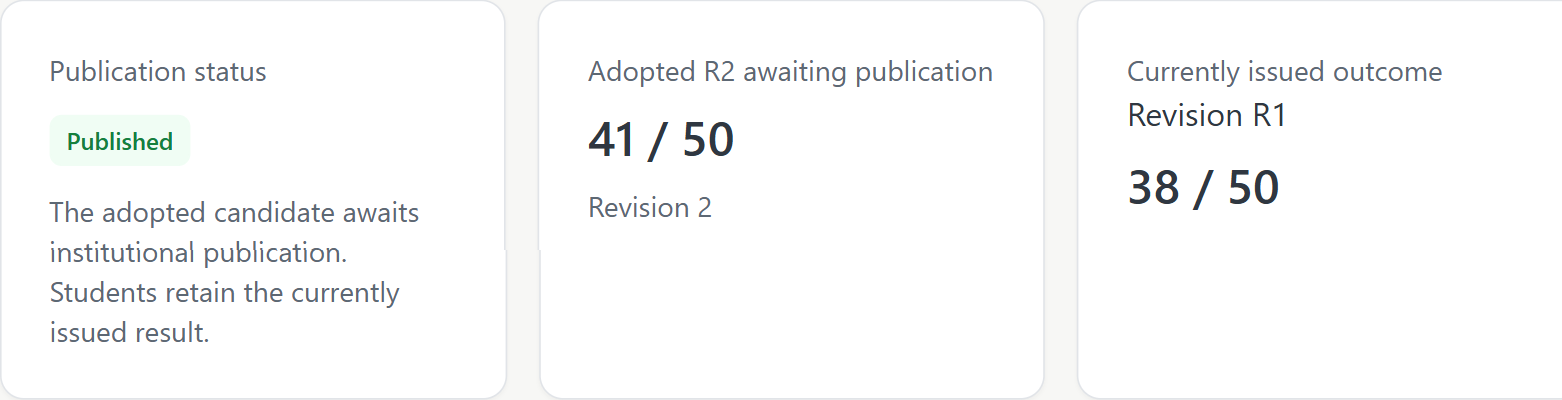
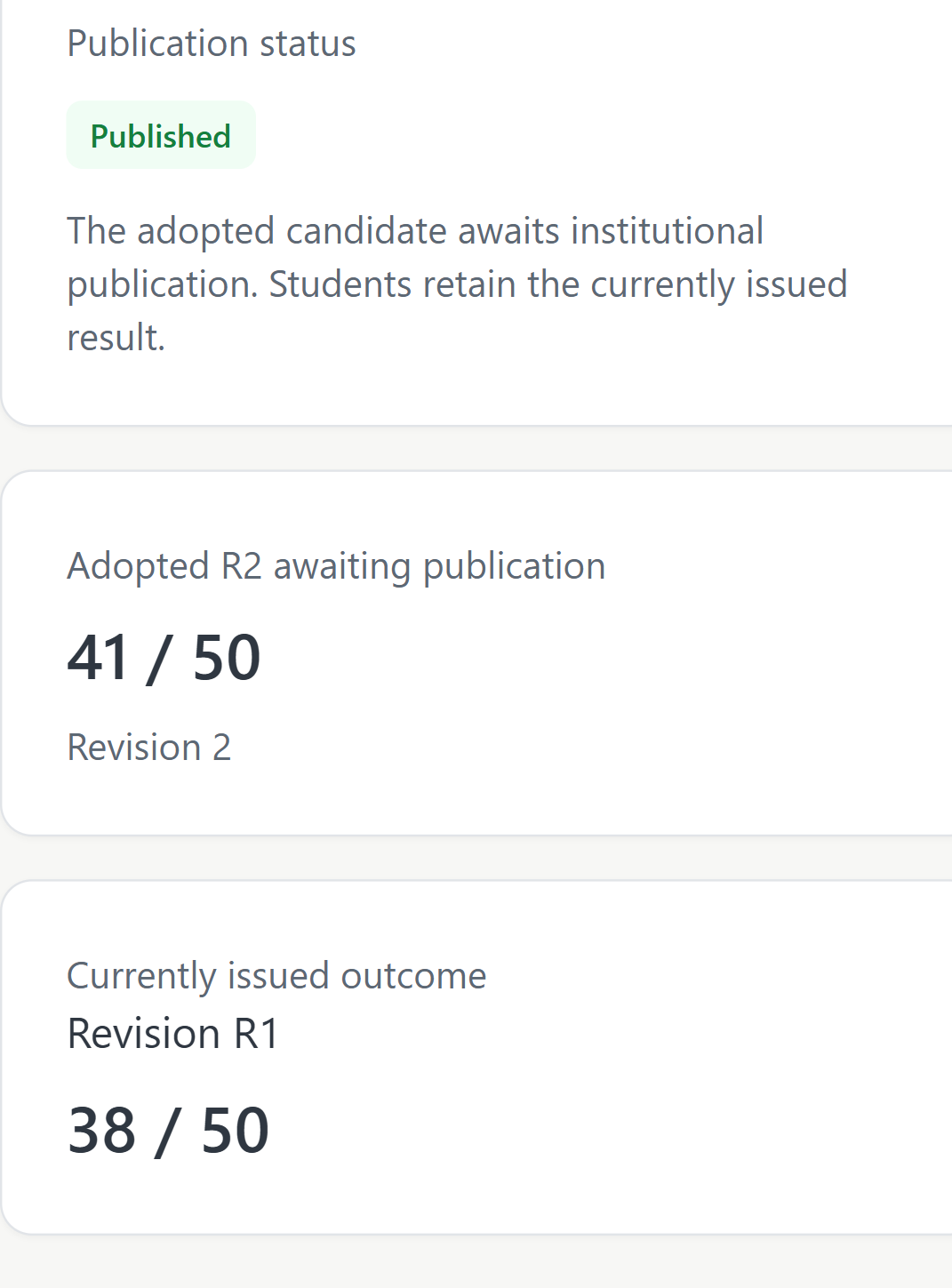
In the adoption example, the current issue is R1 at 38/50 and the reviewed candidate is R2 at 41/50. Both states are visible to the institution while the student continues to see 38/50. The separate RETAIN example keeps a different synthetic record at 35/50.
Responsibilities and prerequisites
Institutions remain responsible for academic configuration, participation accounting, evidence preparation and review, eligible assignments, decisions, and publication. Anonymous assessment depends on reviewed anonymous evidence; it should not be read as a promise of automatic document anonymization.
Independent review depends on usable evidence certification and an eligible independent assignment. Initial publication depends on attendance reconciliation and cohort sealing. Question-group rules determine the scoring requirements; this guide does not claim automatic best-mark selection.
The screenshots show genuine application behavior using a fictional institution and synthetic records. They demonstrate these states, rather than establishing production configuration or availability for a particular institution. Confirm prerequisites and operational readiness during a requested demonstration.
EvalTrack supports human examination work and institutional decisions. Complete automation, guaranteed error elimination, and integrations beyond an agreed scope are not promised. Institutional pricing explains the public pilot and subscription offering.
Product evidence
Real application screens · Synthetic demonstration data. Desktop and mobile captures show the same workflow, with some mobile views limited to an excerpt. Full-size files are available beside each description.
Configured examination

The demonstration examination has three compulsory questions and a choice of two from a second group. Each question has a maximum of 10 marks.
Full-size configured examination screen (PNG)Mobile configured examination screen (PNG)
Question-level faculty assessment

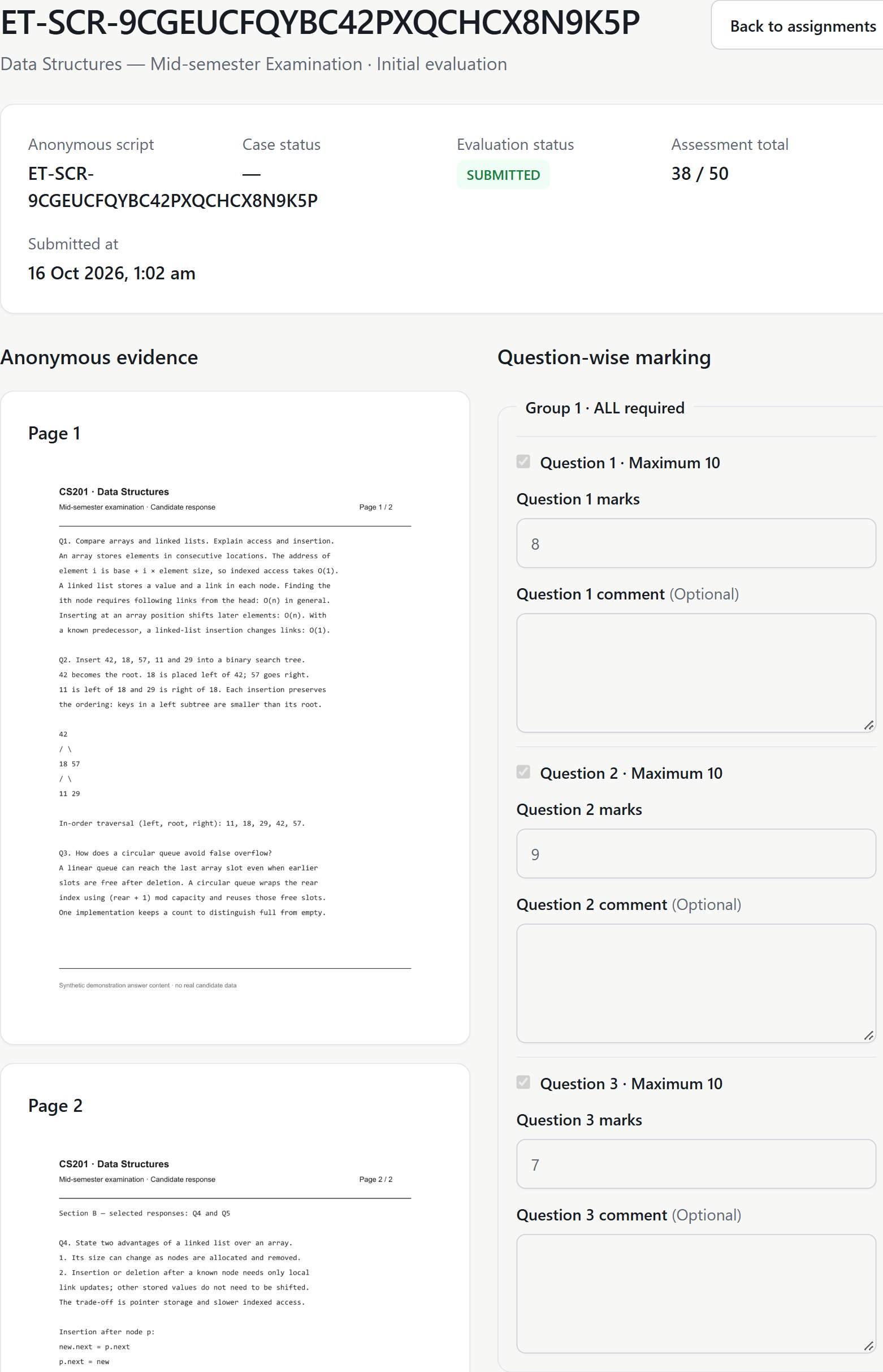
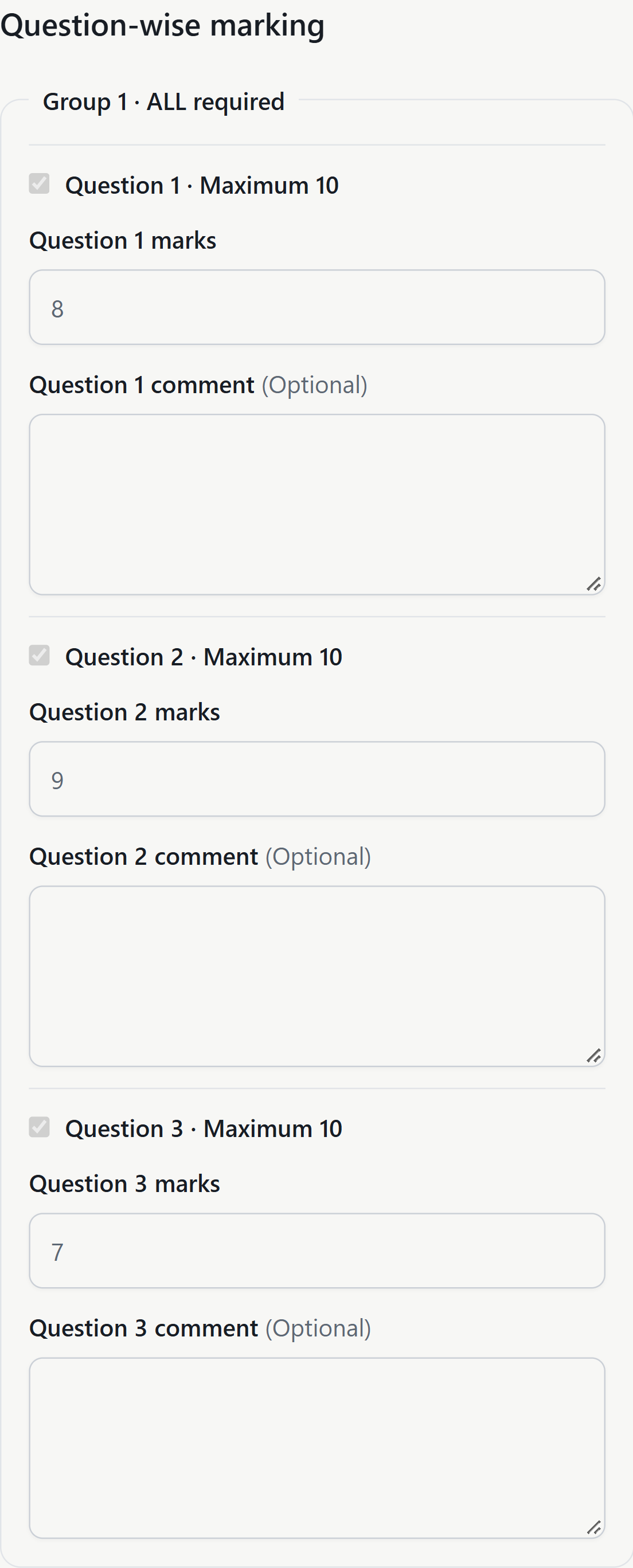
The submitted assessment totals 38/50 across its scoring set. The visible compulsory marks are part of that total. Submission is distinct from institutional publication.
Full-size question-level faculty assessment screen (PNG)Mobile question-level faculty assessment screen (PNG)
Reviewed anonymous evidence

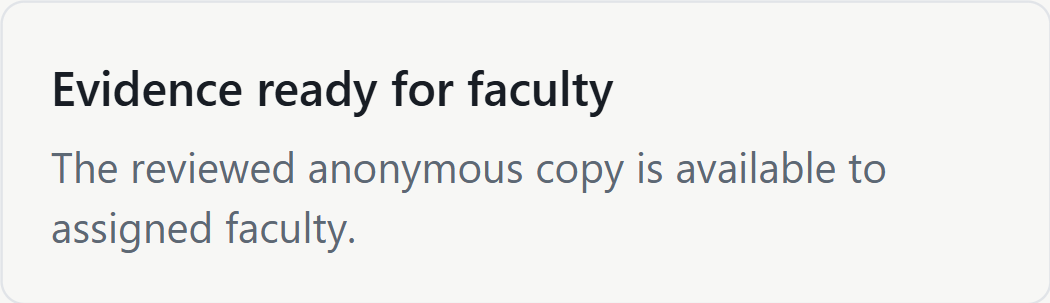
This receipt records evidence readiness. It does not demonstrate automatic removal of identifying information from an uploaded document.
Full-size reviewed anonymous evidence screen (PNG)Mobile reviewed anonymous evidence screen (PNG)

Student’s currently issued result

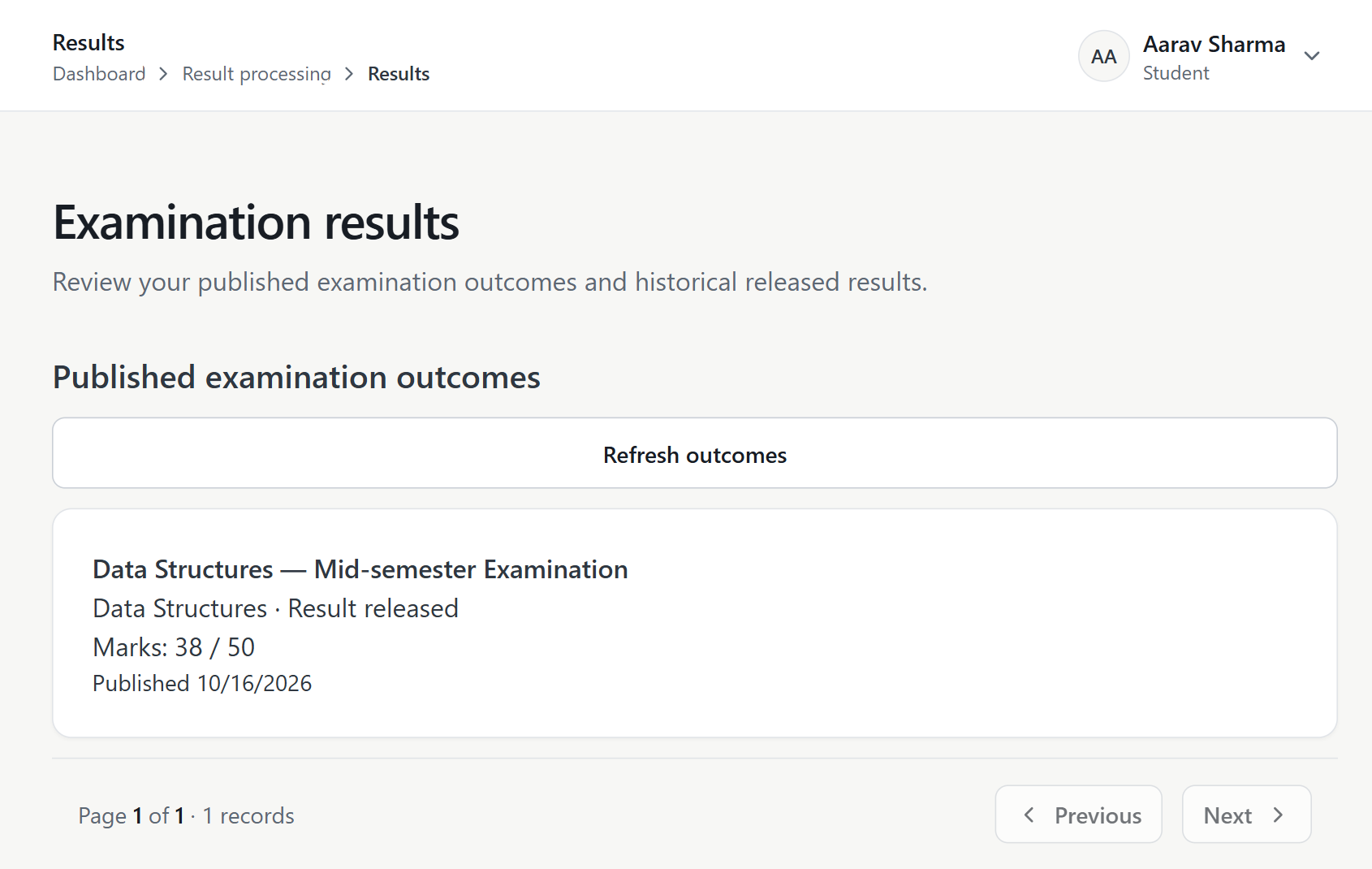
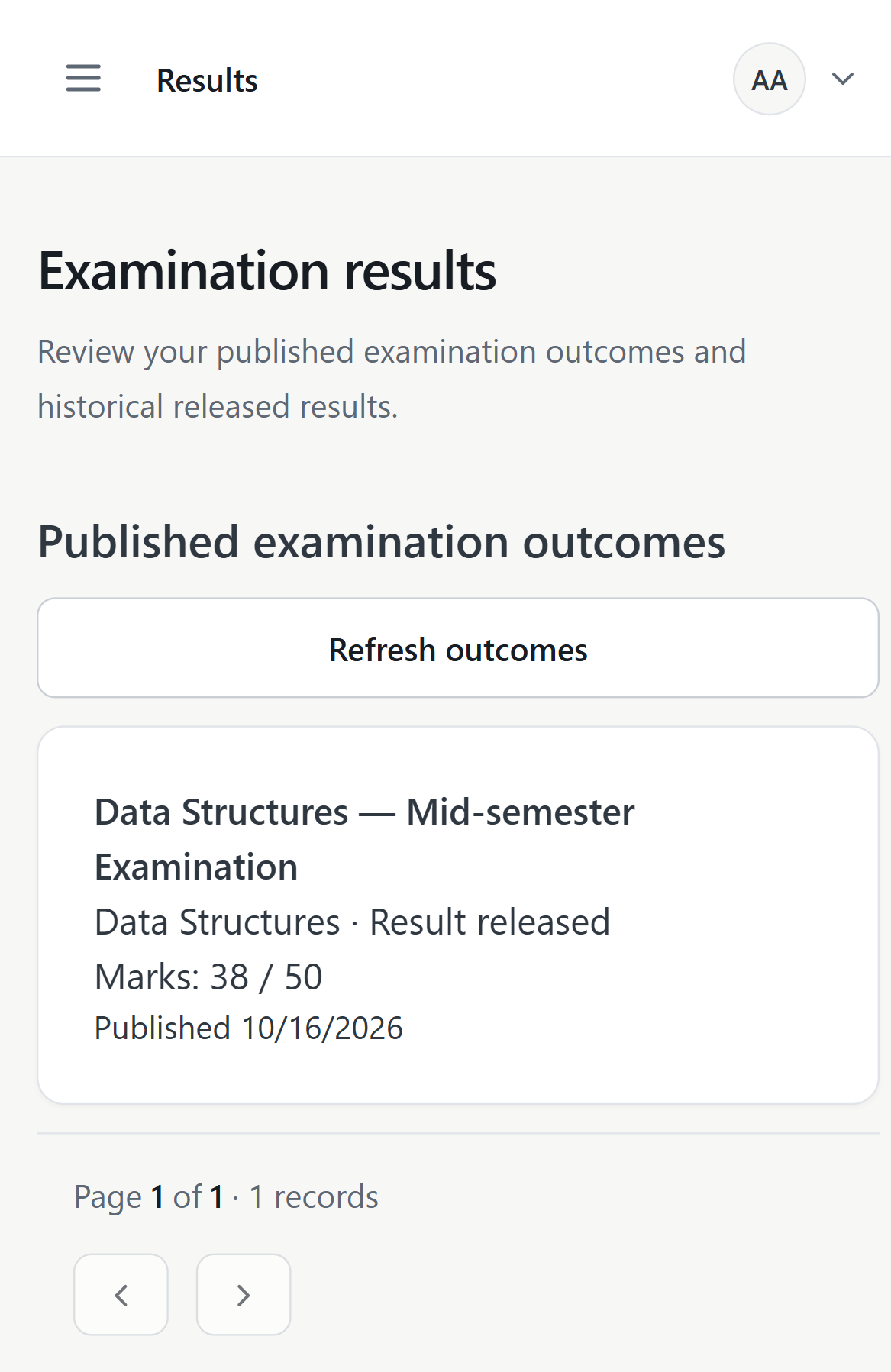
The student sees the issued result. In the related adoption example below, a reviewed 41/50 candidate remains unpublished, so the student still sees 38/50.
Full-size student’s currently issued result screen (PNG)Mobile student’s currently issued result screen (PNG)
Institutional independent-review case

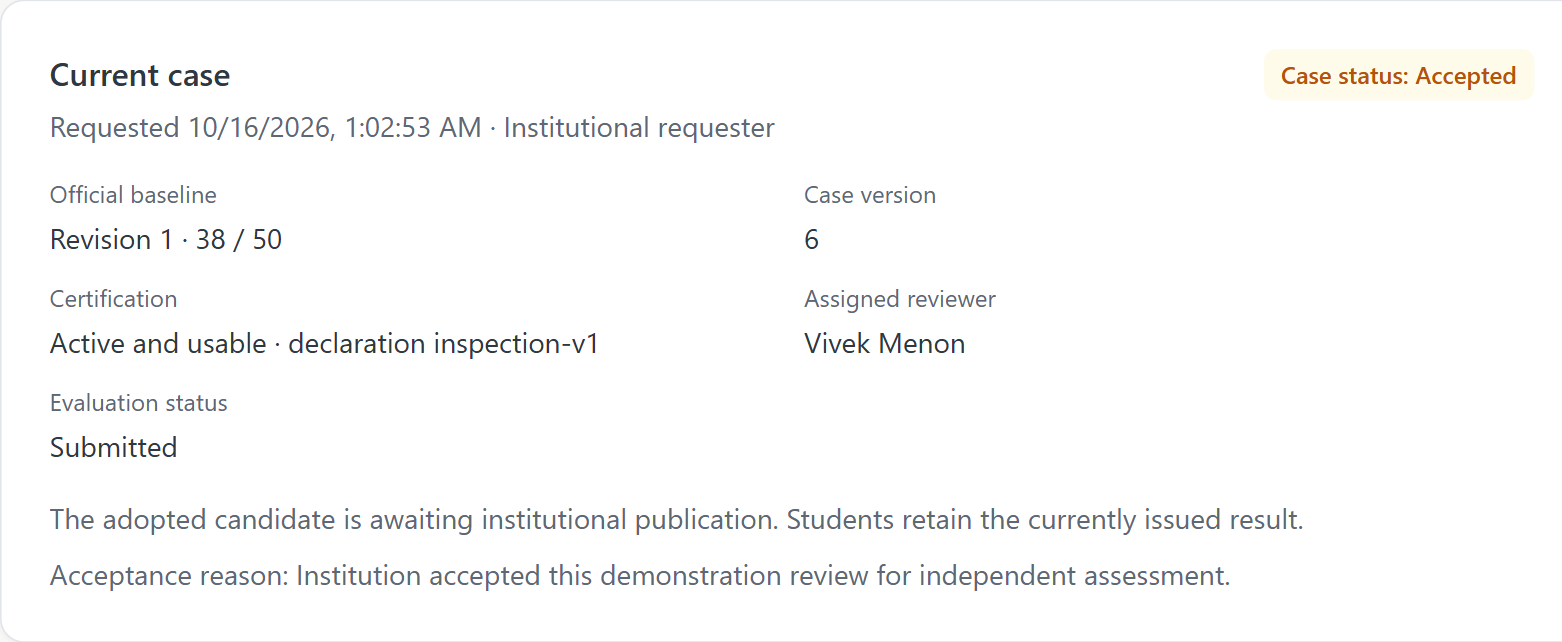
This is the institutional view of the case. The independent reviewer’s assessment view uses anonymous evidence without baseline marks. The case also records that an adopted candidate awaits publication.
Full-size institutional independent-review case screen (PNG)Mobile institutional independent-review case screen (PNG)
Keep the issued result

This separate synthetic record demonstrates keeping the existing result. It is not the 38/50 record used in the adoption example.
Full-size keep the issued result screen (PNG)Mobile keep the issued result screen (PNG)
Adopted review awaiting publication

The publication badge refers to the current issue. Adoption selects a revised candidate; a separate publication operation is still required to replace the issued result.
Full-size adopted review awaiting publication screen (PNG)Mobile adopted review awaiting publication screen (PNG)
Questions and answers
What is EvalTrack?
EvalTrack is an institutional examination management product connecting examination setup, assessment, result publication, independent review, and institutional decisions.
How does its examination lifecycle work?
An institution configures the examination and question groups. Assigned faculty assess reviewed anonymous evidence. The institution accounts for participation and publishes the initial result. An eligible independent reviewer can assess a case against that issued baseline. The institution then keeps the issue or adopts the review; an adopted revision requires separate publication.
How does faculty evaluation differ from result publication?
Faculty evaluation records and submits question-level marks. Institutional publication issues the official outcome after the required participation accounting. A submitted assessment is not itself a published student result.
What happens during an independent review?
An institutional case connects the issued baseline, certified anonymous evidence, an eligible independent reviewer, and the submitted review. The reviewer assesses anonymous evidence without seeing baseline marks, and the submitted scoring membership remains fixed.
Who decides whether a reviewed assessment is adopted?
The institution records the decision to keep the issued result or adopt the reviewed assessment. Submitting a review does not automatically replace the issued result.
When does an adopted revision become the officially issued result?
After a separate institutional publication operation. Adopting the reviewed assessment creates a candidate awaiting publication; adoption and publication are distinct operations.
What does the student see before a revised result is published?
The student retains the currently issued result. The demonstration shows an issued 38/50 result while an adopted 41/50 candidate is still awaiting publication.
Which workflows depend on institutional configuration?
Academic scope, question groups, eligible participation, faculty assignment, evidence review, and independent-review eligibility require institutional setup or action. Initial publication follows attendance reconciliation and cohort sealing. Review requires usable evidence certification and an eligible independent assignment. Confirm operational readiness for your institution during a demonstration.